Somatic yoga is a body-led practice that combines movement, breath, and nervous system awareness to help the body release stored stress patterns. Unlike conventional yoga, which focuses on physical form and flexibility, somatic yoga works with sensation, the actual felt experience of the body in the moment, as its primary guide.

The body holds the pattern. The practice is to listen to it, not override it.

In a conventional yoga class, the goal is often a pose achieved, a stillness reached, a performance of alignment. In somatic yoga, there is no goal-state. If you arrive tense, that tension is information. If your breath is shallow, that shallowness is a signal. The practice is to track what the body is communicating, and to move in response to it rather than in spite of it.

Somatic yoga is educational and experiential in nature, not clinical therapy. It is designed for people who are functioning on the outside but feel disconnected, exhausted, or unable to shift patterns through mindset work alone. It works at the level where patterns are actually held: in the nervous system.
The science underneath

Why the body
and not the mind.

When the nervous system detects a threat, real or perceived, the brainstem takes over. The prefrontal cortex, the thinking brain, goes partially offline. This is why you cannot think your way to calm. Logic does not regulate the nervous system.

The brainstem reads sensation. Movement, breath, and body awareness send safety signals directly to it, speaking the language it understands. This is the physiological basis for somatic work.

The vagus nerve is the primary pathway. 80% of its fibres are afferent, carrying signals from body to brain, not the other way around. Safety travels upward from the body first.

The polyvagal ladder

Ventral Vagal

Safety and connection. Rest, presence, creativity, learning. The state the practice helps you return to.

Sympathetic

Mobilisation. Fight and flight. Energy, urgency, anxiety, action: healthy when it moves through, harmful when it gets stuck.

Dorsal Vagal

Shutdown and collapse. Numbness, dissociation, flatness. The body's oldest survival response.

The four survival states

Fight

Forward-oriented mobilisation. Anger, urgency, control.

Flight

Escape-oriented mobilisation. Anxiety, busyness, avoidance.

Freeze

Blended state. High charge, unable to act. Includes functional freeze and fawn.

Shutdown

Full dorsal collapse. Numbness, flatness, dissociation.


In practice

What somatic yoga
actually looks like.

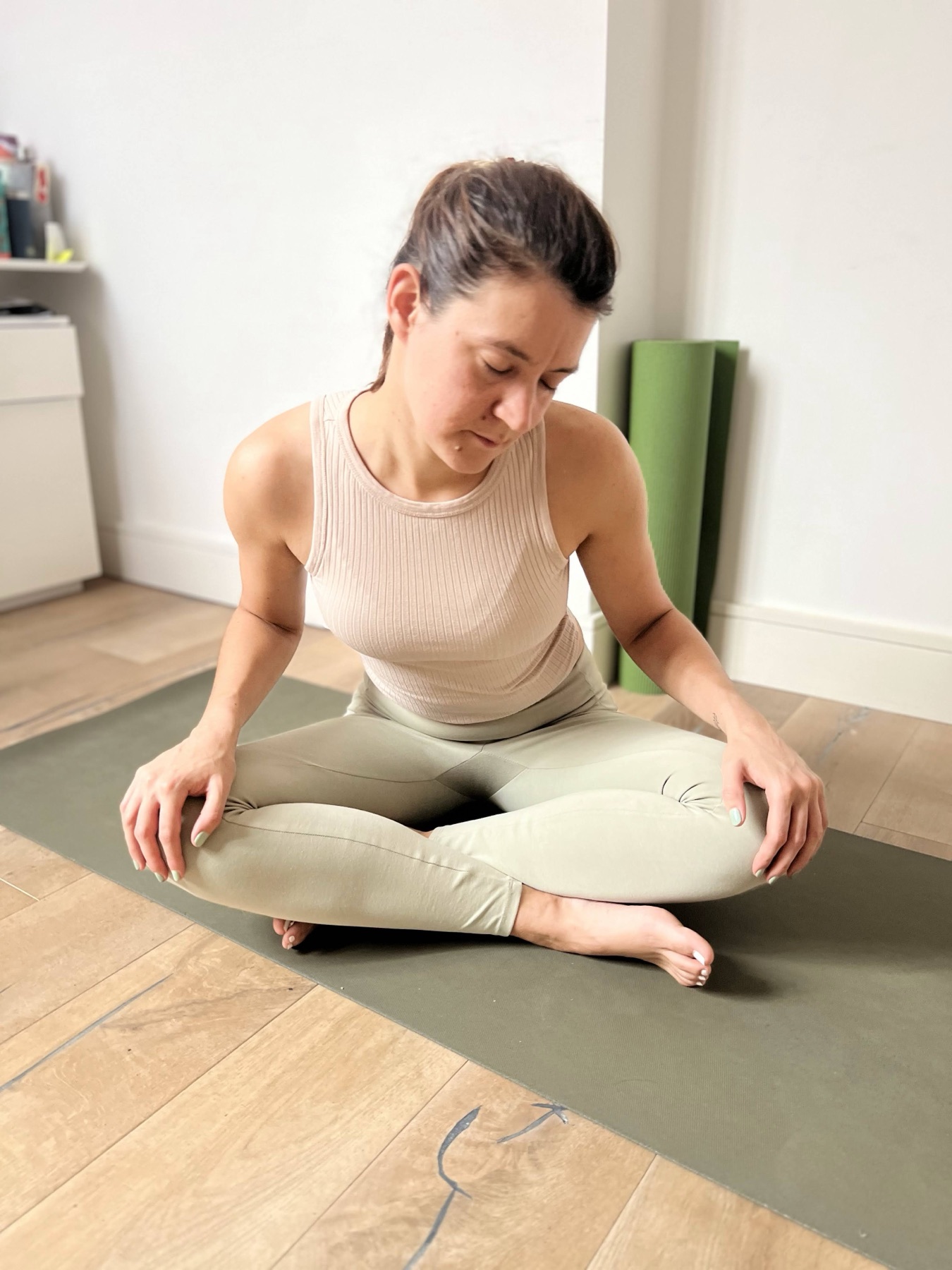
Sensation over form. In a somatic yoga session you are not trying to achieve a pose. You are tracking what your body is communicating. Where is there tension? Where is the breath not reaching? What does this shape feel like from the inside, rather than the outside? That distinction, from performance to perception, is the whole practice.

Breath as a direct signal. Breath is not used as a performance technique in somatic yoga: it is not about breathing "correctly." Breath is the most direct line to the brainstem. How you breathe right now is telling your nervous system whether it is safe. Slowing the exhale, noticing where the breath gets shallow: these are regulation tools, not achievements.

No wrong response. If you fall asleep, that is information. If you feel irritable, that is also information. Whatever the body's response, it is the material of the practice. There is no performance to get right.


Who this is for

If any of this
sounds familiar.

You are functioning on the outside: work, relationships, responsibilities. You feel like you are watching your life from a slight distance. Present but not fully there.

You are always busy, always moving, but slowing down feels genuinely unsafe. Rest does not restore you. You cannot remember the last time you felt still.

You know what you should do: the therapy, the meditation, the self-care. The gap between knowing and feeling is where you live. Mindset approaches have not landed.

You feel numb, flat, or disconnected from pleasure, meaning, or emotion. Even when things are objectively fine. Exhausted but unable to pinpoint why.


Free resources

Start practising
today.


About the practitioner

Clara Louis is a somatic coach and Human Design guide based in London. She works with women experiencing anxiety, burnout, functional freeze, and disconnection, in person in London and online.

Her work is grounded in polyvagal theory and trauma-informed movement. It is educational and experiential in nature, not clinical therapy.

Read about Clara's training and approach →


Common questions

Questions about
somatic yoga.

How is somatic yoga different from traditional yoga?

In traditional yoga, the goal is often a physical or meditative state: a pose achieved, a stillness reached. In somatic yoga, there is no goal-state. The body's current response is the information: tension, breath pattern, sensation. The practice is to track it, not override it. This makes somatic yoga particularly effective for people whose nervous systems are in chronic survival states.

What is polyvagal theory and how does it relate to somatic yoga?

Polyvagal theory, developed by Stephen Porges, describes three branches of the autonomic nervous system: the ventral vagal (safety and connection), the sympathetic (mobilisation: fight and flight), and the dorsal vagal (shutdown and collapse). Somatic yoga works directly with this hierarchy, using movement, breath, and sensation to help the nervous system move toward ventral regulation, not by forcing it, but by creating the conditions in which it can choose to move.

What are the survival states and how does somatic yoga work with them?

The four primary survival states are fight, flight, freeze, and shutdown. Fight and flight are expressions of sympathetic mobilisation. Freeze is a blended state: the body is highly charged but unable to act, and includes classic freeze, functional freeze, and fawn as sub-expressions. Shutdown is full dorsal vagal collapse: numbness, flatness, dissociation. Somatic yoga practices are designed to match the state the body is in, meeting it where it is rather than asking it to perform a different state.

Can I practise somatic yoga at home without a teacher?

Yes. Free guided practices are available on Clara's YouTube channel, organised by theme and survival state. The nervous system library on Skool also offers a video library organised by state, alongside a community space. One-to-one coaching with Clara is available for personalised, ongoing work.


Ready to start

The work begins
in the body.

Somatic coaching, yoga, and free practices. For women in London and online.